Local News · Florence Events Center, Quince Street, Florence, Oregon, USA
“Scary Tales” Turns the Florence Events Center Into a Halloween Storybook Gone Wrong
C.R.O.W.’s haunted maze runs October 28–31, pairing four nights of theatrical frights with a fundraiser for local youth arts—and offering earlier sessions for visitors who prefer a gentler experience.
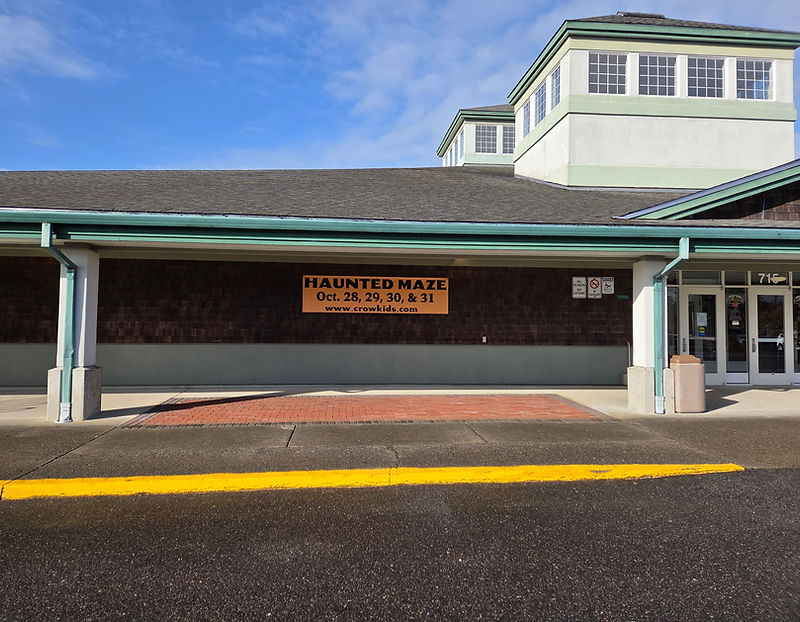
The announcement is hard to miss: an orange banner against the brown shingles of the Florence Events Center, its black lettering advertising a haunted maze for the final four nights of October.
My photographs from October 28 show the banner beside the building’s entrance, documenting the invitation posted outside as the four-night event begins. In the wider view, blue sky stretches above the familiar green-trimmed building. The closer photograph makes the invitation plain: October 28, 29, 30 and 31, with C.R.O.W.’s website printed underneath.
The photographs capture the public face of an event that depends on what visitors cannot see from the sidewalk. Behind that ordinary exterior, the attraction’s creators are promising a journey into corrupted fairy tales, threatening characters and the theatrical pleasures of being frightened.
This year’s maze is called “Scary Tales.” It brings C.R.O.W.’s annual Halloween production to the Florence Events Center at 715 Quince Street, with regular evening sessions running 6–9 p.m. October 28–31.
The premise takes a familiar source of childhood comfort and turns it toward horror. The published storyline centers on a sinister forest dwelling, an ancient crone and a mysterious book containing frightening tales. Recognizable storybook territory becomes the starting point for an experience in which a reassuring ending is no longer guaranteed.
Oregon Coast Beach Connection describes this year’s world as one of shadowy forests, wicked queens and threatening creatures. Its September preview identifies Tina Ferkey, Melanie Heard and Robin Mendolia as the maze’s co-designers.
The publication also explains that C.R.O.W. builds a new production each year, using detailed settings, live performers, effects and theatrical storytelling. Earlier themes have included “Quarantine,” “Carn-EVIL of Terror” and “Abandoned.”
For returning visitors, the changing premise offers a reason to come back. For newcomers, it establishes the attraction as a staged experience with its own creative identity. The interest lies in how a story becomes a place people move through, and how performers use that place to unsettle their audience.
A fairy-tale theme gives that process a useful starting point. Visitors arrive with expectations about familiar stories. The production can then play against those expectations, making recognition part of the suspense.
C.R.O.W.’s maze has attracted attention beyond Florence. Oregon Coast Beach Connection reports annual attendance of more than 1,100 people, including visitors from Oregon, California and Washington.
The attraction’s Oregon Haunted Houses listing identifies it as the website’s 2025 Haunt of the Year winner. That is a specific recognition from a haunted-attraction directory, rather than a government designation or a guarantee about any individual visitor’s experience.
The listing emphasizes an approach rooted in theatre and atmosphere. Its description presents the group’s strength as creating an immersive environment and psychological tension, rather than relying primarily on gore.
That distinction helps explain the creative appeal of this year’s theme. A frightening story can work through anticipation, a character’s behavior or an unexpected change in what seems familiar. A maze gives those techniques a physical setting.
For Florence, the event also offers a chance to see local theatrical work in a different form. Instead of watching performers from a seat, visitors become the moving audience inside the production.
Choosing a session is an important part of planning a visit. The published schedule includes regular evening admission, a sensory-friendly walkthrough and a less-scary hour.
 The regular maze operates Wednesday, October 28; Thursday, October 29; Friday, October 30; and Saturday, October 31, from 6 to 9 p.m.
On October 29 and 30, a Sensory-Friendly Walkthrough runs from 4 to 4:30 p.m. C.R.O.W. describes a guided experience with house lights on, minimal sound, and no costumed actors or jump scares.
Those same dates also offer a Less Scary Hour from 5 to 6 p.m. Sets and props remain, but jump scares are removed and there are fewer, friendlier wandering monsters.
The alternatives make room for different preferences within a household or group of friends. Someone interested in the production’s visual detail can choose a calmer session, while another visitor may prefer the full evening experience.
Neither earlier option removes every frightening image. C.R.O.W. says spooky scenes remain, and children must be accompanied by an adult. Families should choose according to the individual child’s comfort with the material.
Tickets are $12 per person, $44 for a party of four, or $18 for a fast pass to the front of the line. They are sold at the door. The four-person rate saves $4 compared with purchasing four individual admissions.
The schedule gives visitors four evening opportunities, including Halloween itself. Those seeking an earlier, lower-intensity session should pay particular attention to the dates: the sensory-friendly and less-scary options are listed for Thursday and Friday.
The maze is indoors. Its Oregon Haunted Houses listing also identifies free parking and a covered waiting area.
Visitors with specific access or sensory questions should consult C.R.O.W.’s current maze information before choosing a session. The organizer describes a flat-floor layout but also identifies tight corners, fog, special lighting and loud sounds during the regular experience. Physical access and comfort with theatrical effects are separate considerations.
A little planning can help a group choose a visit everyone actually wants. Decide on the intensity first, confirm the time, and then arrange who is attending together.
The fundraiser continues beyond Halloween through the work it helps finance.
C.R.O.W.’s published mission centers on youth arts education and performance opportunities. Its organizational statements emphasize a welcoming environment for rural students, creative exploration and collaboration across generations. The group describes confidence, communication, empathy and problem-solving as goals of its programming.
That mission gives the maze a second audience: the young people who benefit from the organization’s work throughout the year.
C.R.O.W.’s general program FAQs explain that its spring mainstage musical does not charge a participation fee. The organization supplies production essentials such as costumes, scripts, music, sets and lighting, while families provide certain personal items.
Its FAQs place a typical production budget at $40,000–$45,000. That figure describes the organization’s general mainstage production costs; it is not a published budget for this year’s haunted maze.
The distinction matters because free participation still requires substantial resources. C.R.O.W. identifies sponsorships, grants, donations, program advertising, fundraising and volunteer help as parts of the support behind its productions.
Its classes, camps and workshops operate differently: those programs charge tuition, with limited financial-need scholarships available. The organization’s free-participation model applies specifically to its mainstage production opportunities.
C.R.O.W.’s support page identifies several ongoing needs, including technical theatre, scholarships and general operating expenses. Its technical theatre fund supports lighting, sets, costumes and props—the practical ingredients that turn a creative idea into something an audience can experience.
That connection is especially visible in a haunted attraction. The public comes for the finished illusion. Behind it are materials, preparation and people working together to make the illusion hold.
Supporting those capabilities has value beyond one seasonal production. The same broad disciplines—design, performance, coordination and technical preparation—belong to the larger world of community theatre.
Visitors do not need to be regular theatre patrons to take part. A Halloween outing can introduce someone to an organization they may later encounter through a musical, a class or another community performance.
For four nights, the banner on Quince Street points toward that meeting of entertainment and local arts. The advertised destination is a frightening storybook. The broader purpose is helping keep opportunities for creative work available in Florence.
Photo caption: An orange banner outside the Florence Events Center advertises C.R.O.W.’s haunted maze for October 28–31, 2026. Photos by the author.
Sources and citations:
- C.R.O.W. — 2026 Haunted Maze and visitor FAQs
- KLCC Community Calendar — Scary Tales Haunted Maze
- Oregon Coast Beach Connection — Florence’s Haunted Maze Gearing Up for More Frights
- Oregon Haunted Houses — Scary Tales Haunted Maze listing and award information
- C.R.O.W. — About and organizational mission
- C.R.O.W. — Program FAQs
- C.R.O.W. — Supporting theatre, scholarships and operations
Exterior observations are based on my photographs from October 28, 2026. Interior descriptions and event details are based on organizer information and published reporting, rather than an interior walkthrough.