Local News · Florence, Oregon, USA
Four Council Seats and Competing Visions for Florence
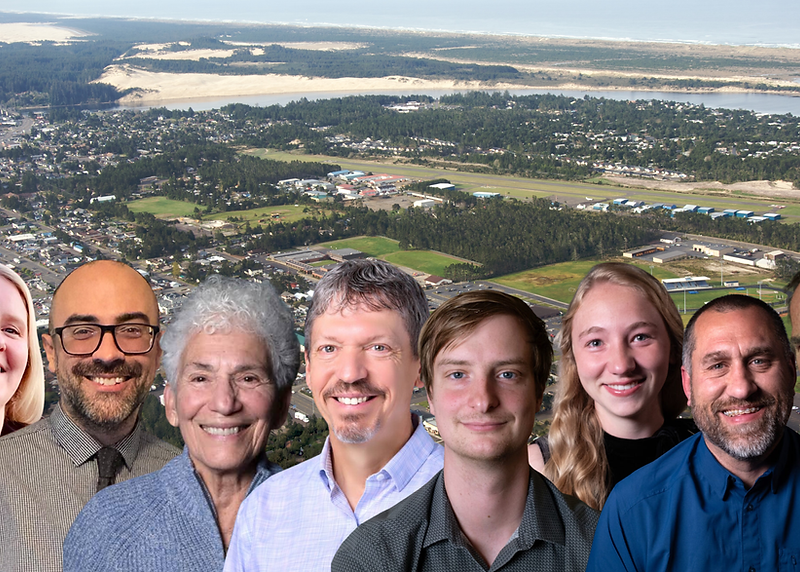
The Florence we live in five years from now is taking shape on this ballot. Eight council candidates have different ideas about where we build, how we spend, and how much authority City Hall should have—and four will help turn those ideas into decisions we all live with.
Source note: This article includes summaries of original candidate reporting by Will Yurman for West of the Tunnel, linked alongside the relevant passages. The summaries, comparisons, and commentary were prepared by Siuslaw Country. Additional sources are identified where used.
A vacant lot, an empty storefront, a permit waiting for approval. These are the ordinary places where Florence’s election promises will meet reality.
The council candidates are offering different answers to what should happen next. Build more apartments within existing neighborhoods. Make room for smaller detached homes. Restrict vacation rentals. Help applicants through City Hall. Hire staff. Reduce fees. Those proposals could change both the appearance of Florence and the experience of living here.
The choices are substantial because voters will fill all four council seats on November 3. The ballot has two separate council contests, each allowing voters to select up to two candidates. City election information.
Council terms
- Two years — Renee Lo Pilato, Mike Webb, Elijah Yager, Haylee Cole
- Four years — Justin Ludwig, Jo Beaudreau, Terry Duman, Ryan Eichelberger
The decision is also about which approaches can work together. Candidates who disagree about surveillance may find common ground on housing. People with different ideas about growth may agree that getting an answer from City Hall should be easier. A useful council will have to work through those combinations.
The housing debate will help determine what Florence looks like. Elijah Yager favors apartments, duplexes, and smaller lots within the existing community. His work with the Siuslaw Watershed Council informs an approach that connects housing, environmental stewardship, and getting around on foot. Source: Will Yurman, West of the Tunnel — Yager interview.

Terry Duman, a contractor and Port of Siuslaw commissioner, also supports smaller lots and easier accessory dwelling units, but places greater emphasis on detached homes. He proposes considering some light-industrial property for residential use. That creates a concrete choice about the land Florence reserves for homes and the land it reserves for employers. Source: Will Yurman, West of the Tunnel — Duman interview.
There is room for agreement between those approaches. There is also a real decision to make about density, building types, and location. The word “housing” can cover a great deal. Residents should be able to picture what a candidate’s proposal would mean on an actual street.

Photo: Will Yurman/West of the Tunnel.
Haylee Cole, a real estate agent who grew up here, emphasizes keeping Florence a place where younger people can establish themselves while preserving its scale and character. She supports workforce housing and reviewing development restrictions. Her position puts a familiar local tension directly before voters: accommodating more people while protecting what residents value about the town. Source: Will Yurman, West of the Tunnel — Cole interview.


Mike Webb and Justin Ludwig introduce another dimension: who gets to use and own the housing. Webb, an incumbent councilor and commercial banker, identifies the Airport Road land-trust project as a model worth repeating. Separating ownership of the land from ownership of the home offers a different route into homeownership. Source: Will Yurman, West of the Tunnel — Webb interview.
Ludwig proposes limits on short-term rentals so more properties can serve residents. He also supports easier accessory dwelling units, more deeply affordable housing, and a permanent site for a year-round homeless shelter. These proposals would affect existing homes and people whose needs extend beyond buying a newly built house. Source: Will Yurman, West of the Tunnel — Ludwig interview.
I find this part of the race especially useful. It gives us specific policies to weigh. A land trust, a rental restriction, an apartment project, and a detached starter home each come with different costs, obligations, and beneficiaries. Florence could pursue several of them. The council would still have to decide which deserve priority and public support.

Photo: Will Yurman/West of the Tunnel.
At City Hall, the disagreement is partly about how to make things move. Renee Lo Pilato, a former Planning Commission member with a background in education, proposes adding building-department staff and a professional part-time grant writer. She also favors no new fees or taxes during the next two-year budget cycle. Her approach would expand the city’s ability to process work and seek funding while placing a limit on new revenue measures. Source: Will Yurman, West of the Tunnel — Lo Pilato interview.

Photo: Will Yurman/West of the Tunnel.
Yager proposes a full-time grant manager and makes a useful distinction about the money that person would pursue: grants are temporary, so projects should be considered with their continuing expenses in mind. The decision to hire would itself need a durable funding plan. Source: Will Yurman, West of the Tunnel — Yager interview.
Cole favors clearer permitting and examining fees for possible reductions. Ryan Eichelberger, whose professional background is in health insurance, emphasizes guidance for applicants, more predictable processes, and exploring ways to reduce or defer development costs. Their proposals direct attention to what a person encounters when trying to build or open something here. Source: Will Yurman, West of the Tunnel — Cole interview; Source: Will Yurman, West of the Tunnel — Eichelberger interview.

Jo Beaudreau, an incumbent councilor and small-business owner, supports clearer guidance, application tracking, and incentives with measurable public benefits. She also explicitly addresses the other side of a fee reduction: the service still has a cost, and another source must cover it. Source: Jo Beaudreau’s campaign website — priorities.
These ideas overlap more than campaign arguments sometimes suggest. Better instructions could prevent avoidable delays. Additional staff could address a workload problem. A targeted fee reduction could help a particular kind of project. Before choosing a remedy, I want the council to establish where the delay or expense actually comes from. Otherwise, we could hire for the wrong problem or cut revenue without removing the obstacle.
The candidates’ economic proposals also point toward different uses of the city.

Photo: Will Yurman/West of the Tunnel.
Eichelberger sees opportunity in vacant buildings along Highway 101. Webb supports exploring expanded convention use at the Florence Events Center and improvements to Old Town parking and streets. Webb describes those larger projects as concepts still needing funding. Source: Will Yurman, West of the Tunnel — Eichelberger interview; Source: Will Yurman, West of the Tunnel — Webb interview.
Duman sees potential in manufacturing. Lo Pilato favors bringing the city, Chamber, and business leaders together to consider economic diversification. She also explicitly connects year-round wages with housing that fits workers’ incomes. Source: Will Yurman, West of the Tunnel — Duman interview; Source: Will Yurman, West of the Tunnel — Lo Pilato interview.
Those proposals suggest different priorities for investment: filling an existing building, expanding visitor business, or making room for another kind of employer. The decisions should be considered together. For example, converting industrial land to housing requires a careful look at which sites future employers might need. Expanding convention business calls for a credible estimate of year-round employment, wages, and public expense. We should be able to follow the reasoning behind each choice. For any prospective employer, I would also want to know what jobs residents could obtain, what training would be available, and how AI or automation might change that work.
The four-year race also includes proposals whose value may be most apparent when daily life becomes difficult. Beaudreau emphasizes a transportation mobility hub and disaster preparedness. Ludwig favors better public transportation and a climate-action plan, alongside his shelter proposal. Source: Will Yurman, West of the Tunnel — Beaudreau interview; Source: Will Yurman, West of the Tunnel — Ludwig interview.
Those priorities bring people without dependable transportation, people without shelter, and residents facing an emergency into the development discussion. A town’s plans should account for them from the beginning. Ludwig’s proposed data-center moratorium adds a separate question about which future industries Florence should welcome; he described it as a precaution and did not identify a pending local project. Source: Will Yurman, West of the Tunnel — Ludwig interview.
Flock cameras expose one of the clearest differences in the field. Lo Pilato and Yager oppose their use. Ludwig favors removal. Beaudreau voted against continuing them. Duman and Eichelberger support retaining them with safeguards. Webb voted to keep them but remains open to revisiting the issue. Cole proposes comparing other providers and, if an acceptable alternative cannot be found, putting the cameras to a public vote. Source: Siuslaw News — candidate responses; Source: Will Yurman, West of the Tunnel — Beaudreau interview.
That range matters. Supporting police technology, supporting this particular provider, and supporting a public vote are distinct positions. Voters should know which commitment they are being asked to endorse. The council chosen in November will help determine how Florence handles the issue from here.
The way residents participate deserves the same concrete attention. Duman wants meeting times that working people can more easily attend. Lo Pilato proposes an annual town hall with two-way discussion feeding into city priorities. These are practical changes residents could judge by whether they make participation easier and more useful. Source: Will Yurman, West of the Tunnel — Duman interview; Source: Siuslaw News — Lo Pilato’s published response.
For me, that is where the conduct of this campaign meets the work of governing. A councilor will have to listen to a resident who opposed them, question a proposal from an ally, and sometimes accept a useful idea from someone they dislike. Personal attacks make that work harder. The ability to disagree without making enemies is a governing skill.
Voters can support ideas from more than one candidate. They can also expect candidates to explain how their proposals fit together. Smaller lots and better permit guidance may reinforce each other. New staffing and limits on revenue require a budget that reconciles both. Housing growth and business recruitment need a shared view of the land available.
Four seats give Florence an opportunity to assemble a council with different experience and enough common purpose to act. The work will begin with specific choices: a parcel of land, a staffing request, a fee, a contract, a project waiting for a decision. That is where the direction of this city will be set.