Local News
Florence Mayoral Candidates: What Could They Do for the City and Its Residents?
Three candidates want your vote. What will Florence—and the people who keep it running—actually get in return?
Source note: This article combines candidate statements submitted directly to Siuslaw Country, campaign materials, and summaries of published reporting and research. Passages drawing on Will Yurman’s original reporting for West of the Tunnel, published by Lookout Eugene-Springfield, are identified and linked below. Other sources are identified alongside the relevant material. The summaries, comparisons, and commentary were prepared by Siuslaw Country.
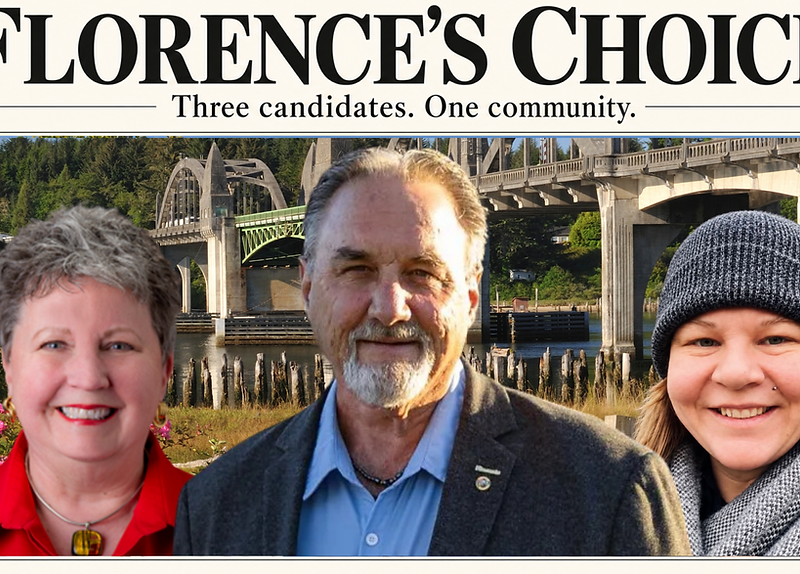
On November 3, Florence will choose its next mayor. Daniel Lofy, Sally Wantz and Shannon Warren each want the job. What matters to me is what they intend to do with it, and what their leadership would mean for the people who live here. A mayor helps decide how public money is spent, which problems receive attention and whether residents feel their voices count. Source: City of Florence — election information.
I want a Florence where people can build a decent life. Where families have a reason to stay, businesses have room to succeed, and growing older does not mean being pushed out by the cost of living. I also want a city that answers its residents and takes care of the services we depend on. The three candidates offer different ideas about how to get there.

Photo: Will Yurman/West of the Tunnel.
Source for the following discussion of Lofy’s submitted proposals: his written statement and answers provided directly to Siuslaw Country.
Lofy grounds his campaign in the 37 years he has called the greater Florence community home and his experience running a construction business. In the statement he sent me, he points to managing budgets, supervising employees and subcontractors, and honoring commitments. He says his first two years would focus on attainable housing, year-round economic opportunity, and dependable infrastructure and public safety.
His housing proposals include removing unnecessary zoning and permitting barriers, giving applicants clear guidance, and putting infrastructure where it can make appropriate housing sites buildable. He supports working with private and nonprofit housing providers, pursuing grants, and considering targeted incentives when there is a clear public benefit. The people he says he wants to serve include working families, seniors, young adults and local employees.
Lofy also wants the city to help existing small businesses grow, make permitting more predictable, strengthen commercial areas and work with schools and workforce organizations. When I asked about better employment opportunities, he pointed to small manufacturing companies. That gives his economic development proposal a direction. The value to Florencians would depend on the businesses that come, the jobs they offer and whether local people can make a living doing them.
He includes roads, utilities, public safety and disaster preparedness in his plans, with outside funding helping the city meet those responsibilities. These are the foundations residents pay for and have a right to expect. New development needs dependable services, and people already living here need to know their neighborhoods will be cared for.
One useful part of Lofy’s response is his willingness to name measures of success: homes completed, permitting times, business openings and closures, grants secured, and projects finished on time and within budget. He promises public reports that explain what is delayed and why. He closes with, “I am running for Mayor to make Florence better at being Florence.” Those reports would give residents a way to judge whether he has done it.

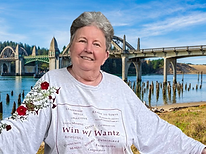
Wantz brings experience from the City Council, where she has served since her election in 2020, and a background in human resources and management. Her campaign puts cooperation and responsible spending at the center of how she would lead. Source: Will Yurman, West of the Tunnel — candidate interview published by Lookout Eugene-Springfield; Source: Sally Wantz’s campaign priorities.
She wants more workforce housing through development incentives, partnerships and outside funding for infrastructure. She also wants to expand childcare access, building on her involvement in establishing Quality Child Care of Florence. That connection deserves attention. A parent can have the ability and willingness to work, yet still be unable to take a job without someone to care for their child. Source: Sally Wantz’s campaign priorities.
Wantz’s priorities include safe drinking water, maintained roads, public works and public safety. She supports grants for infrastructure and calls for respectful public discussion and careful use of taxpayer dollars. Her platform also recognizes Florence’s character and its Tribal and community history as things worth preserving while the city grows. Source: Sally Wantz’s campaign priorities.
In her interview with Will Yurman, Wantz called for greater help for unhoused residents and retirees struggling financially. She supported working with schools and identified skateboard-parts manufacturer RipTide Sports as an example of a business Florence could accommodate. Source: Will Yurman, West of the Tunnel — Wantz interview published by Lookout Eugene-Springfield.
Taken together, Wantz’s proposals recognize that a community’s needs are connected. Housing helps employers retain workers. Childcare gives parents more choices. Dependable services support everyone. Her approach would need to turn those connections into results people can use: a childcare opening, a home within reach, a city service that works when it is needed.
For the housing incentives Lofy and Wantz propose, I want a clear public bargain. If residents help make a development possible, they should know who benefits, what affordability means, how long it lasts and what happens if promises are broken. Public support should come with enforceable obligations and reporting residents can understand.
 Photo: Will Yurman/West of the Tunnel.
In the answers she sent me, Warren names three priorities: accessibility and inclusion, effective and accountable city government, and a Florence where people can afford to build a future. She describes more than 30 years of experience in business management, entrepreneurship and education, including owning businesses in three states and serving on Florence’s Environmental Management Advisory Committee. She wants that experience applied to problems residents encounter in everyday life.
Her accessibility proposal begins with documenting barriers in city infrastructure, then setting priorities, timelines and funding estimates for removing them. After two years, she says residents should be able to see what has been fixed, what is underway and what remains. Her experience navigating Florence in a wheelchair informs that commitment. “Accessibility should not be an afterthought,” she writes. That gives residents a specific starting point and a way to measure progress.

At City Hall, Warren proposes staff training in customer service and procedures, clearer instructions for permits and business licenses, and reasonable expectations for responses. She would establish baseline response and permit-processing times, identify avoidable delays and report progress publicly. She also promises fair treatment of committee applicants, information before important decisions, and explanations of the choices made. Residents should be able to follow what happens after they raise a concern.
On housing, Warren would examine permitting roadblocks, work with developers and nonprofits, and explore grants, city-owned resources and existing programs. She says more efficient permitting alone will not solve the problem. Her aim is workforce and family housing that serves local needs without placing an unreasonable burden on taxpayers, with measurable goals established alongside the council and city staff.
For jobs, she would explore small-scale manufacturing and other sustainable industries, help existing businesses grow and work with employers, schools, the Chamber and regional partners. She also wants more businesses serving children and families. She does not promise a particular industry will come; she says the city must first understand its infrastructure, workforce and resources. Her stated standard is year-round work that pays enough for people to support themselves and their families.
Warren’s homelessness proposals call for cooperation with service providers and nonprofits on safe shelter, bathrooms, hygiene and connections to food and other services. She also recognizes concerns about safety, sanitation and public spaces. She wants the city to identify existing resources and gaps, then develop practical options. Her position gives the city a role in coordinating help while acknowledging that Florence cannot solve every part of homelessness on its own.
On the public safety fee, Warren would review service costs and efficiency before asking people to pay more, and examine alternatives. She would consider whether stronger enforcement of pedestrian-crossing laws could improve safety and contribute citation revenue. She explicitly says that revenue is uncertain, should not drive enforcement decisions, and cannot be promised as a replacement for the fee. She would review the finances and legal requirements with the council and staff before recommending whether to reduce, freeze or replace it. I would judge that idea first by whether pedestrians are safer. Any proposal to depend on citation revenue should explain how enforcement decisions would be protected from pressure to meet a budget.
The candidates also offer ideas about how people spend their lives here. Lofy supports a city parks and recreation department, with volunteers helping contain costs. Wantz supports considering a separate parks and recreation district that could serve an area beyond the city limits. Those choices carry different responsibilities for organization and funding. Source: Will Yurman, West of the Tunnel — candidate interviews published by Lookout Eugene-Springfield.

Flock cameras present a sharper difference. Warren’s response is a firm no: she acknowledges potential investigative benefits but believes the privacy risks outweigh them and wants Florence to discontinue the system. In the Siuslaw News questionnaire, Wantz said she would again move to have the cameras removed. Lofy supported their use with strict safeguards, audits and public oversight, and favored a public vote on continued use after residents receive information about the system’s protections, costs and results. Sources: Warren’s written response provided directly to Siuslaw Country; Tony Reed, Siuslaw News — candidate questionnaire, October 7, 2026. Whatever the final vote, residents deserve clear limits on surveillance, access to the rules governing their data, and a meaningful way to challenge misuse. Public safety authority should remain answerable to the people subject to it.
Every one of these proposals will require the next mayor to work with others. Florence’s mayor and council act collectively on laws, policies and budgets. The mayor also helps develop meeting agendas and represents the city. Leadership means making a case, listening to objections and building enough support to get useful work done. Source: City of Florence — description of the mayor and council’s responsibilities.
That work must reach the household budget. Consider a worker earning $20 an hour for 40 paid hours every week: $41,600 a year before taxes. At $1,500 a month, rent alone takes about 43 percent of that income. Keeping that rent at the usual 30 percent affordability benchmark requires $60,000 in annual household income. This is an illustration, not a claim about every Florence worker or rental. But the point is plain: a housing proposal must consider what people earn. Calling a home affordable does not make the payment affordable to the person who needs it. Source for the housing-cost-burden benchmark: U.S. Census Bureau. Illustrative calculations by Siuslaw Country.
I would also measure the candidates’ economic promises by the power workers have to improve their own circumstances. Wages, dependable hours, benefits and the ability to organize and negotiate belong in that assessment. A new business opening is a beginning. The people doing the work should have a meaningful voice in the conditions under which they do it.
Ownership deserves a place in this discussion, too. I want the candidates to consider worker-owned businesses, resident-owned housing and community land trusts alongside business recruitment and conventional development. Florence should explore ways for residents to hold a greater stake in the places where they work and live, and to participate in the decisions that shape them.
The need for assistance is part of the community these candidates hope to lead. Census estimates for 2020–2024 put SNAP receipt at 15.9 percent of Florence households and Medicaid or other means-tested public health coverage at 32.4 percent of civilian residents living outside institutions. United Way reported in December 2025 that Florence Food Share had served 4,700 people across its broader service area. These groups overlap and cannot be added together or treated as a count of low-paid workers. They are a reminder that city decisions reach households with very different resources. Source: U.S. Census Bureau — 2020–2024 ACS five-year SNAP data, Table B22003; Source: U.S. Census Bureau — 2020–2024 ACS five-year health coverage data, Table C27007; Source: United Way of Lane County — food insecurity reporting; Source: Florence Food Share — service area.

We also have to consider the work people will be doing in the years ahead. Stanford researchers have found weaker hiring patterns for young workers in occupations highly exposed to AI, while cautioning against interpreting that as proof of widespread job losses caused by AI. Service robots already have commercial uses in hospitality and cleaning. Florence’s plans for business growth and employment should account for changing skills and give residents a way to prepare. Source: Stanford Digital Economy Lab — research by Erik Brynjolfsson, Bharat Chandar and Ruyu Chen; Source: International Federation of Robotics — professional service robot report.
I have not seen a local workforce program for AI and robotics in the candidate statements and platforms reviewed for this article. Oregon has, however, begun planning through a state-government AI action plan and an education plan that includes AI literacy. The next mayor and council will still have to consider how preparation reaches people here. Recruiting an employer and preparing residents for its jobs should go together. If technology makes businesses more productive, I want that progress reflected in workers’ pay, security and opportunities. Workers should have a voice in changes to their jobs and a fair share of the gains. Source: Oregon Governor’s Office — state-government AI action plan; Source: Oregon Department of Education — 2026–2032 STEM Education Plan.
For Lofy, the test will be whether his housing and business proposals produce homes people can afford and opportunities that sustain them. For Wantz, it will be whether cooperation brings practical help to families and dependable services to the community. For Warren, it will be whether her proposed reviews and partnerships remove accessibility barriers, improve city services and advance housing and year-round employment. Each deserves to be judged by the work they propose and the results they can deliver. Their success should also be measured by whether residents gain a meaningful say in the economic and public decisions shaping their lives.
Residents should be able to see what comes first, what it costs and who is responsible for carrying it through. They should hear when a project falls behind, and why. Public trust grows when people can follow a decision from the promise to the spending to the result.
The vitriol surrounding this race deserves a clear response. Whatever candidate we support, we are responsible for the way we treat one another. Personal ridicule and reckless accusations make it harder to examine the choices before us. A disagreement over who should be mayor should never become permission to strip a neighbor of their dignity.
Criticism should be grounded in evidence, with room for an answer. A political label is a poor substitute for explaining what a candidate has actually said or done.
That standard applies to every camp, including our own. I expect Lofy, Wantz and Warren to practice the respect they ask of others and to reject personal abuse even when it comes from someone supporting them. We can argue forcefully and hold people accountable while recognizing their humanity. The people we disagree with today will still be our neighbors after the votes are counted. Florence’s next mayor will have a duty to serve them, too.
Florence is home to people who have spent a lifetime here and people who are just beginning to build one. All have a stake in what happens next. I want our next mayor to take that responsibility seriously enough to make clear commitments and report honestly on the results. Two years from now, the residents of Florence should be able to point to the things that improved. That is the standard I would apply to anyone asking for our vote.